




Contract neutrality needs an economic floor for freelancers
Why sector-specific minimum rates can protect vulnerable freelancers without regulating the top of the market

Contract neutrality raises a simple question: how much should basic protection depend on the legal form in which someone works? In the Netherlands, employees have a statutory minimum wage and extensive social protection, while genuine freelancers can remain self-employed even when their rates are structurally too low to finance pension, disability risk, sickness, business costs and non-billable time.
That creates a persistent economic gap in the current Dutch system. A freelancer can be legally independent, yet still compete with employees partly because important costs and risks have been shifted from the employer to the individual. This article argues that greater contract neutrality therefore also requires an economic floor for genuine freelancers: sector-specific minimum rates based on real market research into average billable hours and the actual costs of self-employment.
That matters because the Dutch Constitution makes subsistence security a concern of government and requires rules on the protection of people who work (Articles 19 and 20). At EU level, Principle 12 of the European Pillar of Social Rights says that workers and, under comparable conditions, the self-employed should have adequate social protection. The 2019 Council Recommendation asks Member States to close protection gaps for non-standard workers and the self-employed.
The objective is not to determine what every freelancer should earn. It is to prevent genuine self-employment from competing with employment simply because essential costs and risks have been left out of freelance rates.
Contract neutrality does not require identical contracts
Contract-neutral thinking has been discussed in the Netherlands for years. The Wetboek van Werk 2025 proposed broader protection regardless of contract type, while the NBBU has previously proposed basic social protection for all workers and later described a fully contract-neutral system as political “wishful thinking”.
A recent critique in CHRO raises a concern: a sweeping system could restrict contractual freedom and impose protections on highly paid freelancers who neither need nor want them. But that is mainly an argument for targeted protection, not for leaving the bottom of the freelance market without an economic floor.
The fact that most freelancers may be satisfied and well paid does not mean that protection at the lower end is unnecessary. Most employees also earn more than the statutory minimum wage; that has never been an argument for abolishing the minimum wage.
The Dutch gap: genuine freelancers can still be paid too little
Dutch policy currently focuses mainly on whether someone is legally an employee or self-employed. In June 2026 the Netherlands enacted a legal presumption of employment based on an hourly rate. The law enters into force on 31 December 2026. The reference amount is €38 per hour at the 1 January 2026 price level and is indexed with the statutory minimum wage, meaning that the threshold is expected to be around €39 at the start of 2027.
The calculation behind that threshold is important. The government assumes that two-thirds of a self-employed worker’s working time is billable and one-third is non-billable. It therefore applies a 50% correction to the calculated hourly cost to account for non-billable time. The remaining third covers activities such as administration, acquisition and other time that cannot be charged directly to a client. The government based this assumption on data from the Dutch zzp panel dating from 2012. That assumption is too generic and old for a labour market in which billable hours differ substantially between professions.
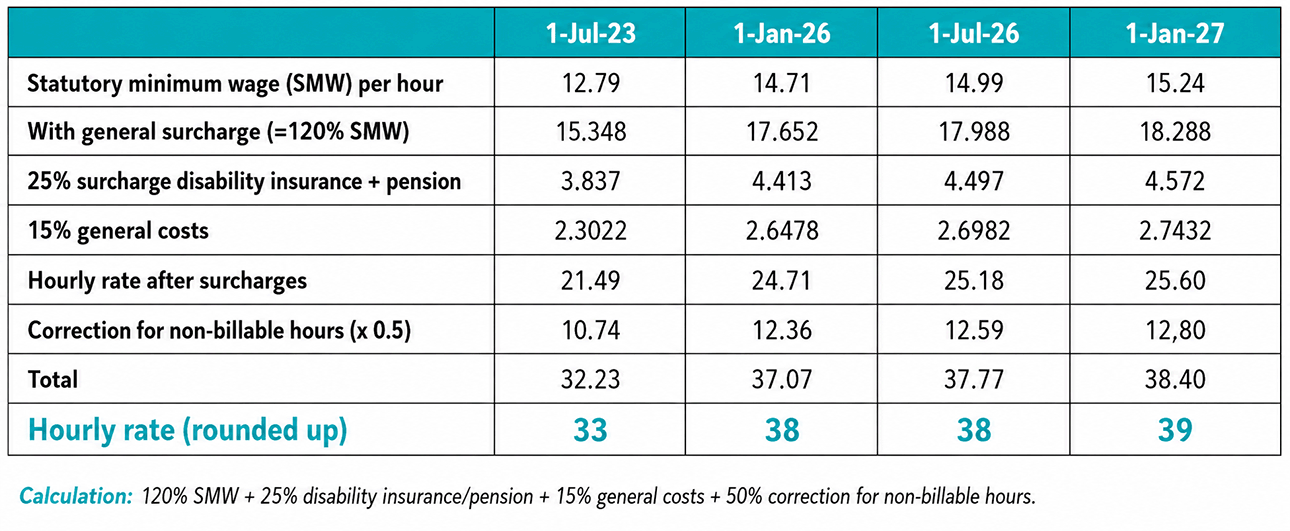
Two-thirds billable corresponds to about 26 billable hours in a 39-hour working week. That may be realistic in some markets, but not in others. In parts of the cultural and creative sector, research points to much lower billable shares. In the AV sector, for example, research cited in my ZiPconomy analysis found about 62% billable time, while other professional groups can be lower still. A single national assumption therefore produces very different annual incomes depending on the market in which someone works. I explain why I favour brackets based on realistic average billable hours in Eerlijke minimumtarieven voor zelfstandigen met schijven per beroep and discuss the importance of these assumptions in more detail in Een zzp-tarief vergelijken met een cao: waar het mis kan gaan.
The threshold itself is not a minimum freelance rate. A worker below it can invoke the presumption and the client must then show that no employment relationship exists. If the person is genuinely self-employed, employee rights do not follow simply because the rate is low. That leaves a group that is legally independent but economically vulnerable. I wrote about this gap in Te zelfstandig voor bescherming.
Protection is about the bottom, not the average
Many freelancers are satisfied with self-employment. That is good, but it says little about whether the bottom needs protection. Most employees also earn above the minimum wage; that does not make the minimum wage unnecessary. According to CBS, 4.4% of self-employed people without employees lived in a poor household in 2024, compared with 1.7% of employees. In culture, recreation and other services the rate among self-employed people was 8.0%.
A freelancer charging €100, €150 or €300 per hour is therefore largely irrelevant to the question of a minimum floor. A floor is designed for the point where bargaining power and market conditions no longer produce a sustainable rate. Above it, freelancers remain free to negotiate whatever their expertise and market value allow.
When low rates become a market problem
An individual freelancer can run an unsuccessful business. They may have too few clients, position themselves poorly or have weak marketing skills. That remains part of entrepreneurship.
The problem is different when low rates are structural across a market. If research shows persistent oversupply, weak bargaining power and rates that do not cover the normal costs of self-employment, telling every individual freelancer to negotiate better or leave the profession does not solve the underlying market imbalance.
That distinction is central to my proposal. It does not protect a freelancer against a lack of demand, poor positioning or an unviable individual business. It addresses a different problem: existing demand for professional work being purchased at rates that are structurally too low to cover the normal costs and risks of self-employment. A minimum rate would not keep an unsuccessful business alive or guarantee anyone enough assignments. It would only set a floor for the price of professional work that is actually purchased.
I discuss why market forces can fail to correct low freelance rates in my ZiPconomy article Marktwerking: waarom het in sommige sectoren hapert voor zzp’ers.
One flat rate ignores the number of billable hours
The same hourly rate can produce very different annual incomes. A freelancer may work full-time but cannot necessarily invoice a full working week. Working full-time as a freelancer may result in 18, 22 or 28 billable hours. Acquisition, administration, preparation, travel, professional development and gaps between assignments all take time, and the balance differs by market.
The figures below should be read as an illustration, not as definitive national averages. They are based on freelance customers of one Dutch bank (Knab), and individual figures may differ from other research. For example, other research puts journalists at around 24 billable hours per week rather than the 26 shown here. It’s important to research the number of billable hours per sector. These hours should not be based on assumption or old data.
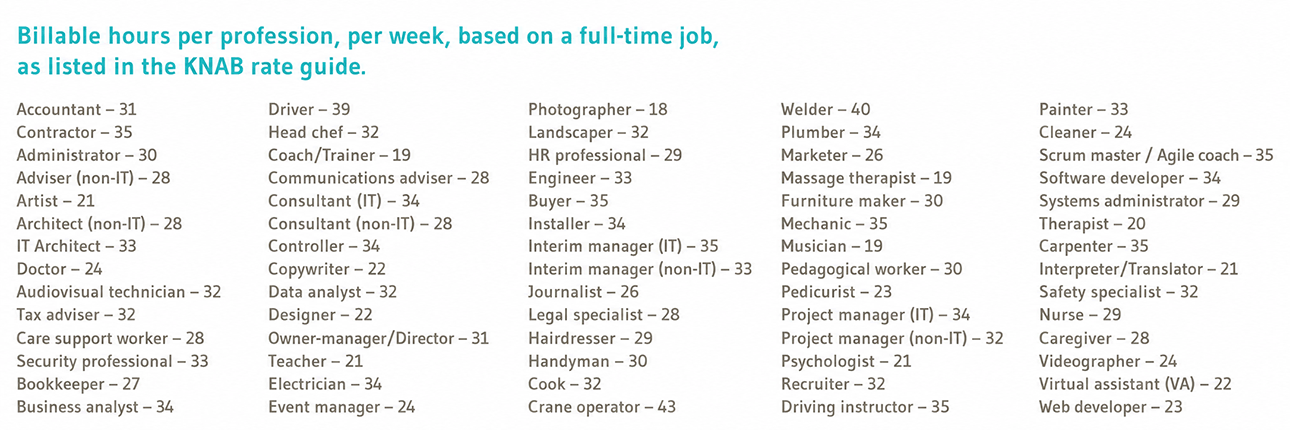
What matters for this argument is the very large variation between professions. It shows why assuming that every freelancer can bill roughly two-thirds of their working time is too simplistic. A realistic calculation should use current research into average billable hours within each specific market or profession.
The issue is not that freelancers cannot calculate their own rate. They can. The issue is that in markets with structural oversupply, concentrated buying power or weak individual bargaining positions, the calculated rate is not always what clients will pay. I discussed that market problem in Marktwerking: waarom het in sommige sectoren hapert voor zzp’ers.
As a simple illustration, at €38 per hour and 44 working weeks, 21 billable hours a week produces €35,112 annual turnover; 30 hours produces €50,160. The 44 weeks are a modelling assumption to allow for holidays, sickness and other periods without billable work, not a legal rule.
A sustainable minimum rate cannot be calculated until we know how many hours freelancers in that market can realistically bill
A sector-specific floor based on average billable hours
My proposal for the Dutch freelance market is to calculate the floor from the average billable hours that a full-time freelancer can realistically achieve in a particular market. To keep the system manageable, professions could be grouped into six brackets: ≤18, 19–21, 22–24, 25–27, 28–30 and ≥31 billable hours per week.
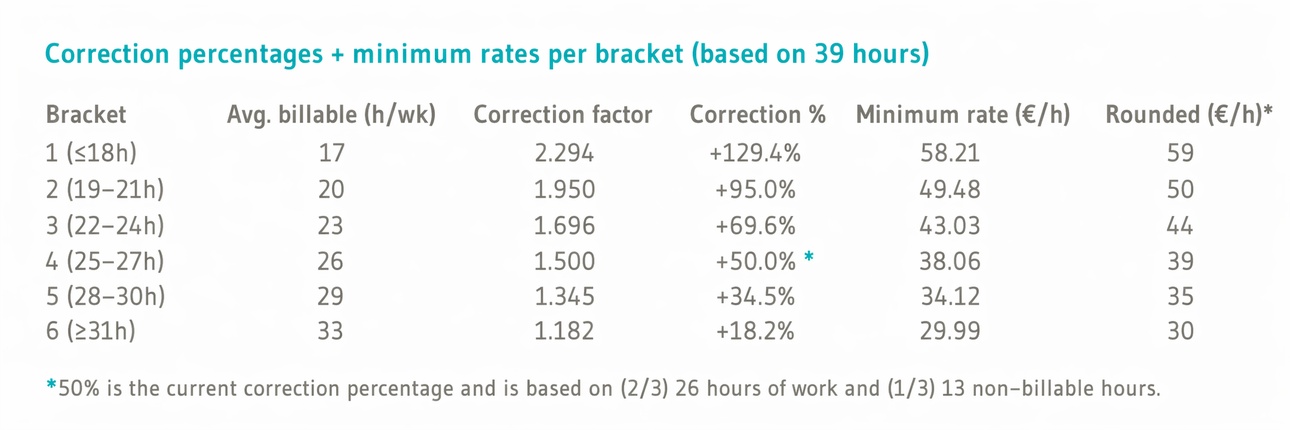
The calculation should then include a socially acceptable baseline income and realistic business costs, pension provision, disability cover, sickness, holidays and non-billable time. Professions should be assigned through current labour-market research, not by bargaining over how low a rate a sector can afford. I developed the bracket approach further in Eerlijke minimumtarieven voor zelfstandigen met schijven per beroep.
The market average is only a calculation method. It does not guarantee an individual freelancer enough assignments, and a client cannot be held responsible for whether that freelancer reaches the average. Finding work, competing and running a viable business remain entrepreneurial risks.
What matters here is the scale of the differences. That is precisely why billable hours should not be estimated or assumed for an entire sector. They need to be measured through current labour-market research for the specific profession or market.
The reason is simple: the assumed number of billable hours directly determines the hourly rate. If a calculation assumes that a freelancer can invoice 30 hours a week when the market reality is closer to 22 or 24, the resulting minimum rate will be far too low. The freelancer is then expected to earn the required annual income in hours that, in practice, cannot be sold. Conversely, a lower and more realistic estimate of billable hours produces a higher hourly rate for the same target annual income.
This is visible in the Dutch AV/Film debate. In my analysis of its Fair Pay calculation, the model assumed 1,348.8 billable hours a year, based on 80% billability (about 30 hours a week, based on 45 weeks per year). That difference is not a minor technical detail: it materially changes the hourly rate needed to reach the same annual income. Research for the broader cultural and creative sector pointed to about 62% billability, equivalent to roughly 1,045 billable hours a year, or about 23 hours a week over 45 working weeks.
A credible minimum-rate calculation therefore starts with evidence about how much time freelancers in that specific market can actually bill.
A floor can reduce one incentive for bogus self-employment
Sector-specific minimum rates would not determine whether someone is legally an employee. They could, however, tackle an important economic incentive behind bogus self-employment: in the Netherlands, freelance labour can still be cheaper than employment because not all of the costs and risks of self-employment are necessarily reflected in the rate.
An employee’s labour costs include more than salary. Employers pay social-insurance contributions, employees receive paid holidays, and employers generally have to continue paying at least 70% of wages for up to two years during sickness. They need to provide for periods without work, holidays, pension, business costs and loss of income through sickness or disability.
Freelancers have to finance periods without work, holidays, pension, business costs and loss of income through sickness or disability themselves. Disability is a particularly clear example: around three-quarters of Dutch self-employed workers are currently not insured against it. The Dutch government says costs are often a reason, while some self-employed workers cannot obtain affordable insurance because of age or health. The proposed mandatory basic disability insurance is not yet in force.
This creates a distorted form of competition when freelance rates are too low to finance those costs. The client receives the flexibility of freelance labour and a lower labour cost, while much of the long-term risk remains with the freelancer. In sectors where low freelance rates have become normal, the financial advantage therefore ends up mainly with the parties buying the labour.
A freelancer should not be cheaper simply because costs that would exist in employment have disappeared from the calculation. They have not disappeared; they have been transferred to the freelancer.
A properly calculated sector-specific floor makes those costs visible in the rate and reduces the incentive to use freelance labour merely because it is the cheaper option. I explored this in Waarom het rechtsvermoeden de economische prikkel achter schijnzelfstandigheid niet wegneemt and Waarom de Zelfstandigenwet ook over zzp-tarieven moet gaan.
Keep the brackets tied to reality
Markets change, so the brackets should be reviewed regularly. AI is one reason. ILO research on generative AI finds that transformation is more likely than wholesale job replacement, with increased exposure in several media- and web-related occupations. That does not tell us whether billable hours will rise or fall in a specific market, but it shows why rate calculations should not be frozen for years.
The objective is not to prescribe a market rate, but to calculate an economically defensible minimum floor via market research → average billable hours per sector → annual working capacity → necessary costs/provisions → required turnover → minimum hourly floor per sector.
A floor for the bottom, freedom above it
Full contract neutrality may be too broad if it means putting every worker under the same legal regime. A narrower principle is more useful: genuine self-employment should not mean that all economic protection disappears. The state defines a floor; the market determines every price above it.
A sector-specific minimum is a floor, not a standard or fair price. Freelancers with enough billable hours at €100–€300 per hour will barely notice it. The people who do notice are those in markets where professional work can currently be bought below a sustainable level. Above the floor, entrepreneurship remains free. Below it, the contract form no longer determines whether full-time professional work has a realistic chance of providing a living.
measure average billable hours in a market, calculate what the average freelancer in that market needs to finance a sustainable full-time practice, and use that to establish a sector-specific floor.
Sources and further reading
- Dutch Constitution, Articles 19 and 20
- European Commission — Access to social protection
- Staatsblad 2026, 158 — legal presumption based on hourly rate
- CBS — Poverty among workers and self-employed people
- CHRO — Critical view of contract neutrality
- NBBU — Contract-neutral system in the political debate
- ILO — Generative AI and jobs: a 2025 update
- ZiPconomy — Market forces and low freelance rates
- ZiPconomy — Sector-specific minimum-rate brackets
- ZiPconomy — Legal presumption and the economic incentive
- ZiPconomy — Comparing freelance rates with collective agreements
- ZiPconomy — Genuine self-employed low earners
- ZiPconomy — Why the Self-Employed Act should include rates

About Dutch freelancer Wilmar Dik
Wilmar Dik is a Dutch freelancer, professional photographer, cameraman and writer based in The Hague. He has worked as a full-time self-employed professional since 2008 and writes about entrepreneurship, freelance rates, market power, billable hours and the economic position of self-employed workers.
His articles on the Dutch freelance labour market are published by ZiPconomy, where he advocates for practical policies that allow genuine freelancers to work independently while providing better economic protection at the lower end of the market.
Wilmar represents NVF/Beeldmakers in the Working Conditions policy team of the Dutch Association of Journalists (NVJ). He also participates as an independent professional in the Photography sector discussions within Platform ACCT’s fairPACCT programme.
Work and websites
- Reclamebeeld.nl : corporate photography, articles on photography and freelance entrepreneurship
- WilmarDik.nl: photography portfolio
- Mensen.photo : portrait photography
- WilmarPhotography.com : travel and international photography
- Beeldvoorarbeidsmarktcommunicatie.nl : photography and video for recruitment and employer branding
- Tasfilms.nl : International video productions and camerawork
- ZiPconomy : author page with Wilmar’s articles about the freelance labour market
- NVJ : Wilmar Dik’s profile and articles at the Dutch Association of Journalists