





Why sector-specific minimum rates for freelancers make more sense than one flat rate
A minimum hourly rate for freelancers sounds simple. Set one amount below which professional freelance work should not be bought, and everyone knows where they stand.
But the same hourly rate can produce a very different annual income depending on the market. A freelancer may work full-time, while only 18, 24 or 30 hours a week are billable on average. The rest of the time goes into finding assignments, administration, preparation, travel, maintaining skills and gaps between jobs.
That is why the average number of billable hours in a specific market should be the starting point when calculating a floor. If freelancers in a market can bill 24 hours a week on average, the minimum rate must allow them to earn a sustainable income within those 24 hours.
That is why I believe minimum freelance rates should be sector-specific and based primarily on realistic billable hours.
A minimum rate is only a floor
A minimum rate is not the rate freelancers are expected to charge. It should work in the same way as a statutory minimum wage for employees: as an economic floor. Above that floor, freelancers remain free to negotiate their own rates based on experience, quality, reputation, scarcity and demand. The purpose of a minimum rate is much more limited. It should prevent professional freelance labour from being bought at a rate that, on average, is too low to work sustainably.
A freelancer has to pay business costs, taxes, insurance and pension contributions. They also have holidays, sickness and many working hours that cannot be billed to a client. If an hourly rate does not leave enough room for those costs, it may look acceptable on an invoice while still being economically unsustainable.
Billable hours change everything
In the Netherlands, freelancers paid less than €38 an hour can invoke a legal presumption that they are actually employees. The client must then show that the relationship is genuinely one of self-employment. But this protection only helps workers whose relationship has the characteristics of employment. A genuinely independent freelancer earning less than €38 may invoke the presumption, but will not become entitled to employee rights simply because the rate is low.
This leaves a gap: genuine freelancers can still work at rates that are economically unsustainable. That is the gap a sector-specific minimum freelance rate is intended to address.
Billable hours vary enormously between professions. Imagine two freelancers who both work full-time in different markest. One can invoice 21 hours per week. Another can invoice 33 hours.
Over 44 working weeks, at exactly the same €38 hourly rate, the first freelancer has annual turnover of €35,112. The second reaches €55,176.
That is a difference of more than €20,000 in annual turnover even though both work full-time and charge exactly the same hourly rate. The difference is not caused by one freelancer working harder than the other. It can simply be the economic reality of their profession and market.
I have written more extensively about why idle time and non-billable hours are a normal part of self-employment here: Why idle time matters in freelancers’ rate calculations
Idle time is not a personal mistake
Idle time is sometimes treated as if it is entirely the freelancer’s own problem.
Of course, entrepreneurship involves risk. A freelancer who fails to find clients, makes bad investments or offers a service nobody wants cannot expect society to guarantee an income.
But not all non-billable time is caused by poor entrepreneurship.
In many professions, assignments are short, irregular or project-based. Time is also needed for acquisition, administration, preparation and maintaining the business. In some markets there are simply many freelancers competing for a limited number of assignments. A freelancer has little influence over the average number of hours that professionals in an entire market can realistically bill.
That makes average billable hours in a specific market a useful factor when calculating an economic floor.
Why one minimum rate does not work
A single national minimum assumes that all freelance markets work roughly the same way. They do not.
If a freelancer can invoice more than 30 hours every week, the hourly rate needed to reach a minimum annual income can be relatively low.
If another freelancer can only invoice around 20 hours, the required hourly rate will be much higher.
That does not mean the second profession is more valuable. It simply means that fewer paid hours have to finance the same basic costs of working and living. This is the central problem with a one-size-fits-all freelance minimum.
My proposal: work with brackets
We do not need a separate statutory rate for hundreds of individual professions. Professions with similar levels of billable time can be grouped into a limited number of brackets.
For example:
Bracket 1: 18 billable hours per week or less
Bracket 2: 19–21 hours
Bracket 3: 22–24 hours
Bracket 4: 25–27 hours
Bracket 5: 28–30 hours
Bracket 6: 31 hours or more
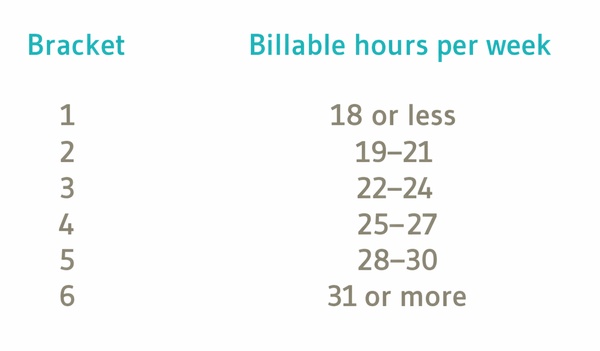
This creates a system that is much closer to economic reality while remaining relatively simple. Professions could be assigned to a bracket using current labour-market research. If necessary, occupations with structurally high business costs could receive an additional correction.
The calculation should also reflect that nobody works 52 full weeks a year. I would use 44 working weeks as a realistic annual average, allowing time for holidays, public holidays, sickness and other normal periods in which no work can be billed. Average billable hours per week should therefore be calculated over those 44 working weeks, rather than multiplied by 52.
The brackets should also be reviewed regularly. Markets change, and developments such as AI can change both demand and the amount of billable work available within a profession.
How should the minimum floor be calculated?
The starting point should be simple: someone who works full-time should at least be able to earn a basic sustainable income. For freelancers, however, full-time work does not mean that every working hour can be invoiced. A freelancer, working fulltime for 38 hours a week might have only 20 or 24 paid hours a week on average. A calculation should therefore start with the minimum income we expect a full-time worker to be able to earn.
Then add the costs that a freelancer has to finance personally, such as business expenses, pension provision, disability protection, sickness and other unavoidable costs.
Finally, divide the required annual turnover by the realistic average number of billable hours within that market. The fewer hours that can realistically be billed, the higher the minimum hourly floor needs to be. The table below shows the principle using different levels of billable hours. These figures are illustrative rather than proposed final statutory rates.
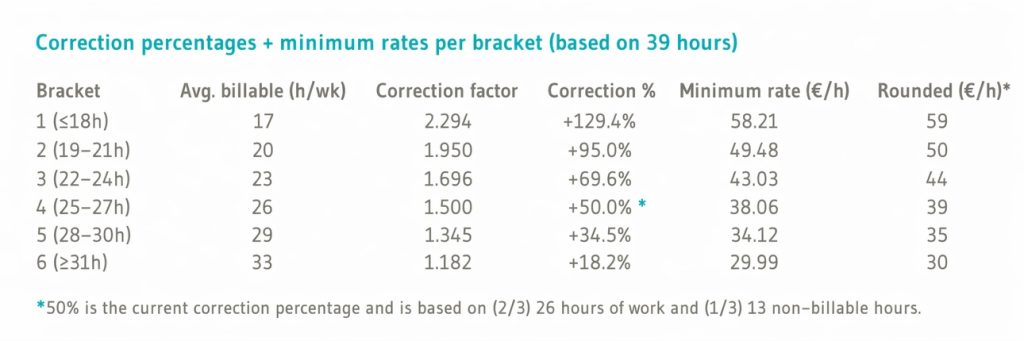
The important point is not whether the final floor is exactly €30, €44 or €59. The important point is that the calculation should follow the economic reality of the market instead of assuming that every freelancer has the same number of paid hours.
Some sectors may have a minimum below €38
A sector-specific system does not automatically mean higher minimum rates everywhere.
In markets where freelancers have many billable hours and relatively low business costs, the economic floor could be below €38. In markets with fewer billable hours or structurally higher costs, it could be considerably higher.
That is exactly why I prefer calculation over one political number. A minimum rate should not be designed to increase freelance prices artificially. It should identify the point below which an average professional can no longer realistically finance the costs and risks attached to self-employment.
It does not guarantee freelancers an income
A minimum rate does not guarantee that somebody will receive enough assignments. A freelancer can still have too little work. Demand can disappear. New competitors can enter a market. Technology can change a profession. Those risks remain part of entrepreneurship.
My proposal only addresses the price of professional work when that work is actually bought. I do not want to guarantee that freelancers can sell enough hours. I want to prevent the hours they do sell from being bought structurally below an economically sustainable floor.
The average number of billable hours is therefore a calculation method, not a guarantee for the individual freelancer. A client cannot be held responsible for whether a freelancer actually reaches that market average. It is simply used to determine what hourly rate is needed, on average, to make full-time self-employment economically sustainable in that market.
A fairer labour market for freelancers
Hiring a freelancer can be cheaper than employing someone because costs and risks such as paid leave, continued pay during sickness, pension contributions, social insurance and periods without productive work are shifted from the employer to the freelancer. That is part of genuine self-employment, provided the rate gives the freelancer enough room to finance those costs and risks.
The problem arises when a client gets both the flexibility of freelance labour and a substantially lower labour cost, while the freelancer earns too little to provide for pension, disability, sickness and periods without assignments. In the Dutch debate on bogus self-employment, that price advantage matters: it can give companies a financial incentive to organise work through freelancers even when the work could also be performed by employees.
A properly calculated minimum floor reduces that incentive. Companies can still hire freelancers for specialist knowledge, flexibility or temporary capacity. But using a freelancer mainly because professional labour can be bought unusually cheaply becomes less attractive.
At the end of the day, a freelancer should not be the cheap option. Genuine self-employment is not inherently cheaper than employment; the costs and risks are simply organised differently. If hiring a freelancer is substantially cheaper, there is a good chance that some of those costs and risks have not been properly included in the calculation.
Calculate the floor instead of guessing it
Self-employed workers are not one homogeneous group. A consultant who can bill nearly every working day operates in a different economic reality from a journalist, photographer, teacher or creative professional who may spend a large part of the week on non-billable work.
Policy should recognise that difference. That does not require hundreds of individual minimum rates. A limited number of brackets based on realistic billable hours, combined where necessary with typical sector costs, would already be much more accurate than one generic threshold.
A minimum rate should not determine what good professional work is worth. It should only determine what is too little. Above that floor, the market remains free. Below it, professional freelance work should no longer be bought.
This article is based on my original Dutch proposal published on ZiPconomy:
Eerlijke minimumtarieven voor zelfstandigen met schijven per beroep
About Wilmar Dik

This opinion piece is written by freelance expert and professional photographer Wilmar Dik, based in The Hague. The Netherlands. I have worked as a full-time freelance photographer since 2008. I write about entrepreneurship and the position of freelancers in the labour market, and advocate for the interests of self-employed professionals.
I represent NVF/photographers in the policy team on working conditions of the Dutch Association of Journalists (NVJ). I participate in the Photography sector discussions (Platform Fotografie) within Platform ACCT’s Fair PACCT programme.
This article may only be reproduced after consultation with me.
Interview with Wilmar Dik about this idea:
Sector-specific minimum rates for self-employed workers can also help tackle bogus self-employment. This is particularly relevant in the Netherlands, where bogus self-employment has become a major political issue. Part of the underlying problem is economic: in some Dutch markets, freelancers can be hired as a cheaper alternative to employees. The client gets flexibility and avoids part of the costs and risks associated with employment, while the freelancer may receive a rate that does not adequately cover pension, disability, sickness, holidays and periods without assignments.
Instead of removing that economic incentive, Dutch policy has largely focused on determining whether someone should legally be classified as an employee. That can protect people who are actually employees, but it does much less for genuine freelancers who remain self-employed while working in markets where rates are structurally too low. I wrote more about this problem in my Dutch article for ZiPconomy, ‘Waarom het rechtsvermoeden de economische prikkel achter schijnzelfstandigheid niet wegneemt’.
More about this:
https://headfirst.group/en/public-affairs/sectorale-minimumtarieven-zzp-schijnzelfstandigheid/
Original Dutch article: https://www.zipconomy.nl/2026/03/sectorale-minimumtarieven-voor-zzpers-kunnen-schijnzelfstandigheid-oplossen/
More about this idea: https://nvj.nl/over/onze-leden/nvf/bestaanszekerheid-voor-zzp-ers-sectorale-minimumtarieven-als-oplossing
Introduction
For years I have seen self-employed workers struggle with rates that are too low to sustain a viable professional life. My conclusion is that the debate about bogus self-employment is too often framed purely as a legal classification problem. In reality, the weakest part of the market also has an income problem. Sector-specific minimum rates can address both: they can reduce bogus self-employment and help prevent poverty among independent workers.
Starting point: real market experience
I have worked as a self-employed photographer since 2008 and have spent years advocating for the position of freelancers, especially at the bottom of the market. From that practical perspective, one pattern keeps returning: low rates, limited bargaining power and weak protection tend to cluster in the same professions. If we want to protect people effectively, we should start with a realistic lower floor that fits the economic reality of their sector.
Why the self-employment debate became a puzzle
The Dutch self-employment debate has long revolved around the legal test for the employment relationship. Since the introduction of the DBA Act, policymakers have kept revisiting the same classification problem. In my view, that has partly been the result of weak representation of the self-employed and partly of a strong lobby from the business side. The result is a debate about status and legal tests while the economic base of many freelancers remains underexposed.
Political will matters
If one missing puzzle piece has been decisive, it is political will. We have known for years that there is a problem, especially at the bottom of the market. People struggle structurally because rates are under pressure. Without political courage, nothing changes. You can debate authority, entrepreneurship and contractual freedom forever, but if you do not improve the income position of vulnerable self-employed workers, the problem simply remains.
What I would add to the puzzle
I would rather solve the puzzle than describe it. Sector-specific minimum rates already take you a long way. Not one generic floor, but calculated lower limits by market or profession, based on average billable hours and cost structures. Those rates should not be purely symbolic. They can be made legally binding, or linked to access to certain forms of social protection.
What problem these minimum rates solve
A minimum rate is not a standard market price. It is a floor, comparable to the minimum wage in employment. Below that level, it is not economically realistic to operate sustainably as an independent professional. In practice, many freelancers work for rates that are not viable because of competitive pressure or weak bargaining power. My proposal addresses several problems at once: unfair competition between employees and freelancers, bogus self-employment, the lack of room to build pension and disability protection, and poverty among the self-employed.
Why billable hours matter
Many people look only at the visible hourly rate. They forget that self-employed workers cannot bill all of their working time. If an editor works 37 hours a week but can invoice only 23 on average, the hourly rate has to be high enough for that person, after costs and non-billable time, to end up at least at the level of the minimum wage. That requires a calculation by sector or occupational group, not one generic threshold.
Why my idea differs from earlier proposals in The Netherlands
Former minister Wouter Koolmees also tried to introduce a minimum rate, but his proposal relied on one fixed amount. My proposal works with bands based on billable hours by occupational group. That way, the system reflects the reality of a market. A flat threshold such as the previously proposed €16 per hour (in 2020) ignores the differences between media, culture, care, construction or technology. If you do not account for those differences in billable hours, it is no surprise that the policy fails.
What about criticism that minimum rates reduce bargaining freedom?
Yes, they reduce freedom at the very bottom end. But right now that freedom is often so wide that it produces socially unacceptable outcomes. The one thing that should no longer be negotiable is a price level that pushes people towards poverty and makes it impossible to build social protection. Everything above that floor remains negotiable. Today, the risks largely sit with the self-employed worker while clients benefit from low rates.
Relationship to the legal presumption of employment
The Dutch legal presumption of employment is built around a rate of €38 in 2026, combining minimum wage logic with assumptions about pension, disability insurance and non-billable time. Some workers may benefit from that presumption, but the threshold remains too generic. There are sectors where people work below €38 and are still clearly entrepreneurs. At the same time, in professions with low billable hours, €38 may still be insufficient to reach a viable income. That is why the economic reality of a sector has to be part of the analysis.
Connection to the future Self-Employment Act
Clarifying the employment relationship is useful. But if the state simultaneously imposes obligations on disability insurance and pension saving without addressing low rates, it shifts the burden to the weakest group. If you calculate the lower floor properly, freelancers in those markets are by definition more expensive than employees, and competition on price falls away. Then the contract form itself becomes less decisive.
Advice to policymakers
Take sector-specific minimum rates seriously. Look at each market and determine what is necessary for self-employed workers to earn at least a viable minimum income. That helps tackle bogus self-employment, reduces unfair price competition between freelancers and employees, and creates financial room for disability insurance and pension saving. With AI and other technological developments increasing pressure on rates, the need for realistic lower floors will only grow.